
What Is A709 Steel and When Do Bridges Need It?
Key Takeaways
- A709 is the ASTM specification for structural steel used in bridges. It covers plates, shapes, and bars.
- The chemistry of A709 Grade 50 matches A572 Grade 50 almost exactly. The real difference is mandatory Charpy V-notch impact testing for tension components.
- AASHTO M270 is the parallel specification. Material is frequently dual certified to both.
- Grades carrying a W have enhanced atmospheric corrosion resistance. Grades carrying HPS are high performance steels with better toughness and weldability.
- Toughness requirements are tied to temperature zones and whether a member is fracture critical, and those requirements have to be on the mill order.
If you have ever looked at a bridge drawing and wondered why the steel callout says A709 Grade 50 instead of the A572 Grade 50 you use every day, you are not alone. The chemistry is close to identical. The price is not, and the paperwork is a different animal entirely.
Bridge work is picking up across the Northeast. Regional forecasts have civil construction leading nonresidential growth through 2027, driven by bridge replacements, transit upgrades, and water infrastructure. If you are a fabricator moving into that work from building projects, A709 is the first spec you need to understand.
What A709 Actually Covers
ASTM A709 is titled the Standard Specification for Structural Steel for Bridges. It pulls several categories of steel under one umbrella, including carbon steel, high-strength low-alloy steel, and quenched and tempered alloy steel. Plates, shapes, and bars all fall within its scope.
The point of having a separate bridge specification is not to create a different steel. It is to attach a different set of requirements to steel that already exists. Bridges carry moving loads, they sit outdoors in whatever the climate delivers, and many of their members have no backup if a crack propagates. A709 builds the testing and documentation around those realities.
A709 vs. A572 and A36: The Real Difference
This trips people up constantly, so it is worth being direct about it.
A709 Grade 36 is functionally A36 with bridge testing requirements attached. A709 Grade 50 has chemistry that matches A572 Grade 50. A709 Grade 50S corresponds to A992, the wide-flange grade used throughout building construction. ASTM deliberately keeps the A709 grades synchronized with their non-bridge equivalents.
So what are you paying for?
Charpy V-notch impact testing. A572 Grade 50 does not require it unless you specifically ask. A709 Grade 50 requires it for tension components, and the results have to meet defined minimums at a defined temperature. That testing is what tells you the steel will behave in a ductile way rather than fracturing when it is cold and loaded.
You are also paying for the documentation trail that comes with it, which on a federally funded project is not optional.
The A709 Grades
Grade 36 and Grade 50
Grade 36 carries a 36 ksi minimum yield. Grade 50 carries a 50 ksi minimum yield and a 65 ksi minimum tensile strength. Grade 50 handles the majority of bridge work because it gets you more capacity per pound than Grade 36.
Grade 50S
Grade 50S is the shapes grade, corresponding to A992. It shows up on rolled beam bridges and on framing members where you would otherwise specify a standard wide flange.
Grade 50W
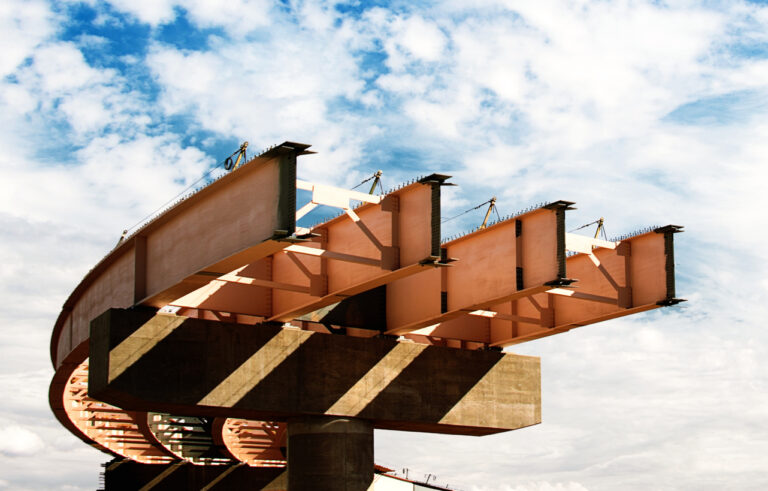
The W stands for enhanced atmospheric corrosion resistance. This is weathering steel, the material that forms a stable rust-colored patina and is designed to be left unpainted in the right exposure conditions.
Grade 50W has the same 50 ksi yield as Grade 50 but different chemistry, with copper, chromium, nickel, and vanadium in the mix. The tradeoff is that weathering steel only performs as intended when the detailing lets it dry out between wettings. Locations with heavy deicing salt exposure or persistent moisture trapped against the steel are where it gets into trouble.
HPS 50W and HPS 70W
HPS stands for High Performance Steel. These grades were developed specifically to improve toughness and weldability over conventional bridge steels, with tighter limits on carbon, phosphorus, and sulfur.
HPS 50W matches the 50 ksi yield of conventional 50W with substantially better toughness. HPS 70W carries a 70 ksi minimum yield, letting designers use less steel for the same capacity on long spans and heavy girders. Both are used where brittle fracture resistance is a priority, which in practice means cold climates and fracture critical members.
One practical note on HPS 70W: quenched and tempered plates in that grade are limited in delivery length from domestic mills, which affects girder splice layouts. Coordinate that with your detailer before the shop drawings go out.
Charpy Testing, Temperature Zones, and Fracture Critical Members
This is the part of A709 that actually drives cost and lead time, so it deserves attention.
AASHTO divides the country into three temperature zones based on the lowest anticipated service temperature at the bridge site:
- Zone 1: 0 degrees Fahrenheit and above
- Zone 2: minus 1 to minus 30 degrees Fahrenheit
- Zone 3: minus 31 to minus 60 degrees Fahrenheit
The colder the zone, the higher the required toughness. Which zone applies to your project is set by the owner or the state DOT, not by you, and it will be in the contract documents.
Separately, members get classified as fracture critical or non-fracture critical. A fracture critical member is one whose failure would be expected to bring down the bridge or a portion of it, because there is no alternate load path. That classification changes two things: the required impact energy goes up, and the testing frequency goes up. Non-fracture critical testing is performed per heat. Fracture critical testing is performed per plate.
Per-plate testing is the expensive part. It also means the mill has to plan for it, which is why supplementary requirements for toughness testing and marking have to be specified at the time of the mill order. You cannot add them after the steel is rolled.
AASHTO M270 and Dual Certification
AASHTO M270 is the transportation industry’s parallel specification to A709. For practical purposes the two track each other closely, and mills commonly certify material to both at once.
If your drawings call for M270 and the mill test report shows A709 with an M270 dual certification, that is normal and generally acceptable. Verify it against the project specification anyway, since some agencies have their own supplementary requirements layered on top.
What to Confirm Before You Place the Order
Bridge steel goes wrong at the ordering stage far more often than at the fabrication stage. Before anything goes to a mill, pin down:
- Grade and yield, including whether weathering steel is specified and whether it is to be painted anyway
- Temperature zone from the contract documents
- Fracture critical designation for each member, marked on the drawings
- Supplementary toughness requirements, which must go on the mill order
- Domestic sourcing requirements, since federally funded work requires steel melted and manufactured in the United States, with coatings applied domestically
- Plate dimensions against mill capability, especially maximum length and thickness for the grade you need
Get those six items settled and most of the downstream problems disappear.
Sourcing A709 and Related Bridge Material
We can source ASTM A709 and AASHTO M270 material on request. Tell us the grade, the zone, the fracture critical designation, and the sizes, and we will price it against the mill calendar so you know the real lead time before you commit.
A bridge package involves a lot more than the girder steel, and most of the rest comes out of stock. We carry steel plate across a wide range of grades and thicknesses, H-piles for foundations, angles and channels for bracing and diaphragms, and galvanized grating for walkways and access platforms.
We also process in house. Our plate processing covers oxy-fuel and high-definition plasma cutting, drilling, and beveling, with flame cutting for shapes that do not come off a standard profile. Plate rolling handles curved sections. Getting material closer to finished before it hits your floor takes real hours out of a bridge schedule.
Request a quote with your bill of materials and we will work through it with you.