Steel Plate Rolling: Custom Solutions for Curved Steel Applications
Key Takeaways
- Steel plate rolling is a fabrication process that shapes flat steel into curved components without compromising its structural integrity.
- 4-roll machines generally offer greater accuracy and efficiency than 3-roll machines by allowing for pre-bending in a single pass, eliminating flat edges.
- The steel’s grade, thickness, and yield strength are critical factors that determine the force and technique required for successful rolling.
- Rolled steel is essential in energy, infrastructure, industrial manufacturing, and architecture for creating components like tanks, pressure vessels, and structural arches.
- A partner like Intsel Steel East, with advanced machinery, metallurgical expertise, and robust quality control is vital to ensuring project success.
From the sleek curves of contemporary architecture to the cylindrical forms of industrial storage tanks, curved steel is an indispensable element in today’s most ambitious projects. Its ability to combine aesthetic elegance with unparalleled structural integrity has made it a cornerstone of modern construction, manufacturing, and infrastructure development. The secret to achieving these precise, often complex, geometries lies in a specialized metal fabrication process: steel plate rolling.
Steel plate rolling is more than just bending metal; it’s a precision-driven fabrication process that demands a deep understanding of material science, advanced machinery, and meticulous quality control. For engineers, project managers, and fabricators, partnering with a specialist in this field is critical to ensuring structural integrity, project timelines, and budget adherence. In this article, we explore the core mechanics of steel plate rolling, its critical applications, and the key factors to consider when sourcing a partner for your next project.
What is Steel Plate Rolling?
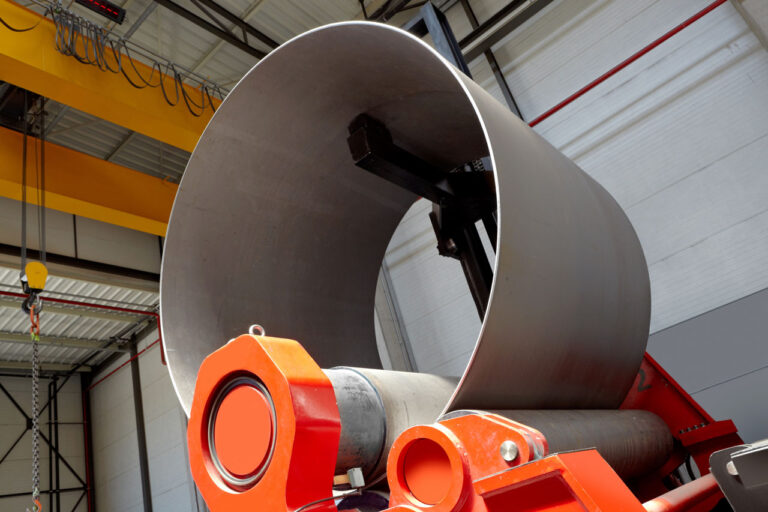
Steel plate rolling is a metal forming process that uses a series of rollers to shape a flat sheet or plate of steel into a cylindrical or conical form. By applying immense, controlled pressure, the rollers bend the plate past its elastic limit, causing permanent deformation. The result is a smooth, consistent arc, cylinder, or custom radius component manufactured to exact specifications without compromising the material’s inherent strength. This process is fundamental for creating everything from large-diameter pipes and pressure vessels to structural sections for bridges and stadiums.
The Core Mechanics: How Steel Plate Rolling Works
The quality and precision of a rolled steel component are directly tied to the machinery and expertise behind the process. While various machine configurations exist, the most common are 3-roll and 4-roll plate rollers.
A 3-roll machine, often arranged in a pyramid or triangular formation, uses the top roller to apply downward pressure while the two lower rollers drive the plate and create the bending moment. This method is highly effective but can sometimes leave a small, unbent flat edge at the beginning and end of the plate, which may require a secondary pre-bending process or trimming.
In contrast, 4-roll machines offer superior precision and efficiency. They feature a top roller, a pinching bottom roller, and two side rollers. This configuration allows the machine to grip the plate securely and pre-bend the leading and trailing edges in a single pass, eliminating the flat spots common with some 3-roll systems. The side rollers perform the actual bending, providing tighter control over the radius and enabling the production of more complex shapes, including multi-radius curves and cones. For applications demanding the highest level of accuracy, a 4-roll process is often the preferred method.
Critical Applications Across Industries
The versatility of steel plate rolling makes it an indispensable process for numerous sectors. Its ability to produce large-scale, high-strength curved components is crucial for projects where structural integrity is paramount.
- Energy & Infrastructure: Rolled plates form the backbone of wind turbine towers, large-scale storage tanks for oil and gas, and penstocks for hydroelectric dams. The process is also used to create the massive cylindrical foundations, or caissons, used in bridge and pier construction.
- Industrial Manufacturing: Many industrial processes rely on components made from rolled steel. Pressure vessels and boiler tanks, which must withstand extreme internal pressures, are prime examples. Rolled cylinders are also used to fabricate heavy machinery frames, industrial ductwork, and conveyor systems.
- Construction & Architecture: Architects and structural engineers use rolled steel sections to create sweeping curves and dramatic arches in buildings, stadiums, and bridges. These aesthetically pleasing designs are only possible through the precise shaping of structural steel plates and beams.
Material Selection and its Impact on Rolling
The success of the plate rolling process is heavily dependent on the properties of the steel itself. Factors like thickness, grade, and yield strength dictate the amount of force required and the machine settings needed to achieve the desired radius without damaging the material. Yield strength, in particular, is the critical threshold that must be overcome to create a permanent bend.
Higher-strength steels, such as A514 or AR400, require significantly more force to roll than standard carbon steels like A36. The material’s ductility also plays a role; less ductile materials may be more prone to cracking under the stress of bending and require a more gradual rolling process or specific heating treatments.
Finding a Partner for Precision Rolling
Choosing the right fabrication partner is just as important as selecting the right material. When evaluating a potential supplier for your steel plate rolling needs, consider their technical capabilities, experience, and commitment to quality.
A partner like Intsel Steel East, with a fleet of modern, well-maintained machinery, including both 3-roll and 4-roll machines to handle a wide range of thicknesses and diameters. Their team of experts have a century of experience working with diverse steel grades and complex project requirements. Contact Intsel Steel East today and ask about their quality assurance processes, certified operators and rigorous inspection protocol to verify dimensional accuracy and material integrity. Their team works as an extension of your team, providing not just a product, but a complete, quality-assured solution.